
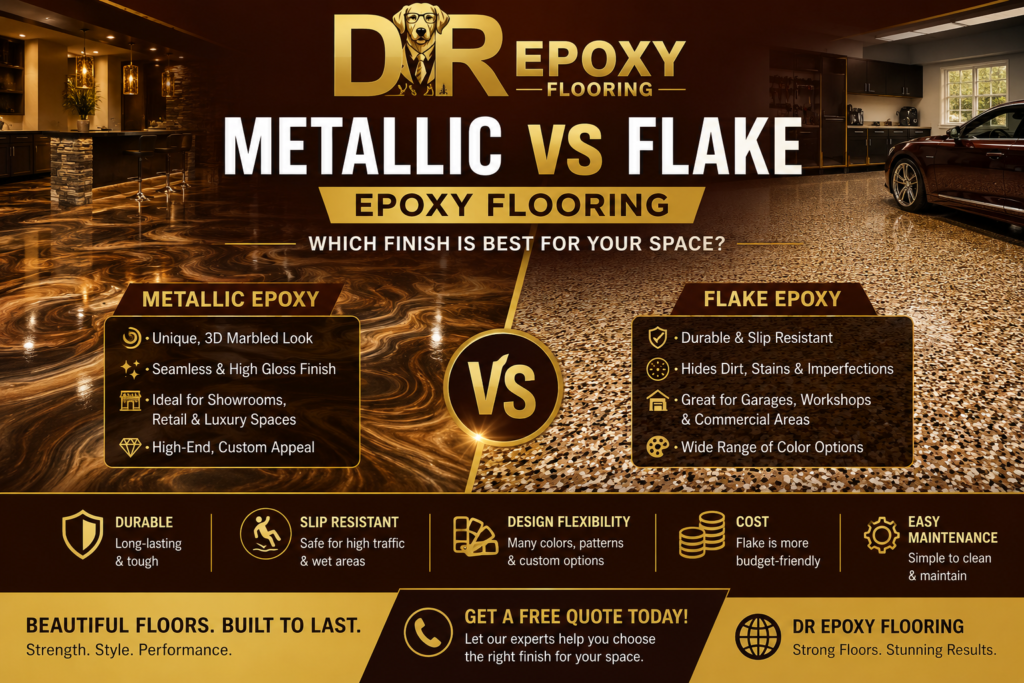
Among all the decorative epoxy flooring installation, metallic and flake are the two most requested for garages, showrooms, and commercial spaces. Both start with the same base material, but the finished floor looks, performs, and costs quite differently depending on which system goes down. This guide compares metallic vs flake epoxy flooring across appearance, durability, slip resistance, and price, then breaks down which finish suits which type of space.
What Is Flake Epoxy Coating?
Flake epoxy coating gets its texture from decorative vinyl or color chips, broadcast by hand into a wet epoxy base coat before it cures. Once the base layer sets, excess flakes are scraped back and a clear protective topcoat seals everything in place. The result looks similar to granite or terrazzo, with a speckled, multi-tone surface available in dozens of color blends.
Flake systems are forgiving to install and reasonably standardized, which is part of why they show up so often in garages and industrial settings. The chips also do a good job of hiding minor imperfections, hairline cracks, and old stains in the concrete underneath, something a smooth solid-color coating cannot manage nearly as well.
What Is a Metallic Epoxy Floor Finish?
A metallic epoxy floor finish uses mica-based metallic pigments suspended in a 100% solids epoxy base. While the epoxy is still workable, an installer manipulates the pigments with tools, air movement, or solvent drops to create swirling, three-dimensional patterns that can resemble ocean waves, marbled stone, or molten metal.
No two metallic floors turn out the same, which is exactly the appeal for showrooms, retail spaces, and high-end residential interiors. The trade-off is skill: a rushed or inexperienced application often looks muddy or streaky rather than dramatic, so metallic work tends to be reserved for installers with genuine experience manipulating the pigment.
Metallic vs Flake Epoxy Flooring: Durability and Maintenance
Both finishes sit on top of a genuinely tough epoxy base and can last 10 to 20 years with reasonable care, but they age differently. Flake floors tend to be easier to touch up because the speckled pattern hides a patched section fairly well. A scuffed or chipped area on a metallic floor is much harder to blend back in, since the swirled pigment pattern is unique to that pour and cannot be recreated exactly.
Day-to-day maintenance is similar for both finishes: regular sweeping, occasional mopping with a pH-neutral cleaner, and avoiding harsh solvents that can dull the topcoat. Neither finish needs waxing or resealing anywhere near as often as tiled or timber floors.
Slip Resistance and Safety Considerations
Flake systems naturally add a bit of texture underfoot, and installers can broadcast extra grit or a slip-resistant additive into the topcoat for garages, workshops, or commercial kitchens where the floor might get wet. Metallic epoxy is typically finished with a high-gloss topcoat to show off the pigment’s depth, which looks striking but offers less natural grip.
For wet or high-traffic commercial areas, a matte or satin anti-slip additive can be added to a metallic topcoat, though this slightly softens the glassy 3D effect that makes metallic floors distinctive in the first place. It is worth discussing this trade-off directly with an installer rather than assuming either finish is automatically safe for every environment.
Design Flexibility: Colors, Patterns, and Customization
Flake epoxy coating comes from a standardized chip chart, which makes it easier to match an existing color scheme or repeat the same look across multiple rooms or locations. This consistency matters for businesses with a specific brand look to maintain across sites, or homeowners coating a garage that needs to connect visually to an existing color palette.
Metallic epoxy works the opposite way. Because the pigment is manipulated by hand, no two pours look identical, even using the same color combination. That uniqueness is often the whole point for a feature floor, but it also means a metallic floor cannot be reliably repeated in a second room to match exactly, which is worth knowing before committing to metallic across a multi-room project.
Cost Comparison: Metallic vs Flake Epoxy Flooring
Price is usually the deciding factor once the aesthetic preference is settled. Current pricing for professionally installed epoxy flooring typically falls into these ranges:
- Solid color epoxy (baseline): $3 to $7 per square foot
- Flake epoxy coating: $5 to $10 per square foot
- Metallic epoxy floor finish: $8 to $15 per square foot, occasionally higher for intricate, multi-color artistic designs
- A standard two-car garage (400 to 600 square feet): roughly $2,000 to $5,400 installed, depending on finish and prep work
- Commercial epoxy flooring: $4 to $15 per square foot depending on the facility, traffic load, and system thickness required
The gap between flake and metallic mostly comes down to labor. Metallic application takes a more experienced hand and more time per square foot, and that shows up directly in the quote.
Garage Epoxy Flooring: Which Finish Wins?
For a standard garage, flake epoxy coating is usually the more practical choice. It costs less, hides oil stains and minor concrete flaws effectively, and holds up well under tire traffic, dropped tools, and everyday wear. Flake is also the more common pick for garages doubling as a workshop, since a busy space tends to show scuffs and scratches sooner.
Metallic still has a place in garages built more for display than storage, such as a dedicated space for a car collection, where the owner wants the floor itself to read as a feature rather than just a durable surface.
Commercial Epoxy Flooring: Which Finish Wins?
Commercial spaces split more evenly between the two, depending on the type of business. Retail stores, showrooms, hotel lobbies, and restaurants often lean toward metallic epoxy floor finishes because the floor doubles as part of the interior design, and the higher cost per square foot is easier to justify over a smaller footprint.
Warehouses, manufacturing floors, and vehicle bays generally favor flake epoxy coating instead. These spaces prioritize slip resistance, chemical resistance, and the ability to withstand forklifts and heavy foot traffic, over pure visual impact.
Choosing Between Metallic and Flake for Your Space
There is no universal right answer between metallic vs flake epoxy flooring. The decision comes down to how the space is used day to day, how much of the budget is set aside for flooring, and whether the floor needs to disappear into the background or become part of the visual statement. A few quick questions tend to settle it:
- Does the floor need to hide stains, cracks, or general wear? Flake usually wins.
- Is the floor meant to work as a visual centerpiece? Metallic usually wins.
- Does the color need to match exactly across multiple rooms or locations? Flake is more predictable.
- Is budget the primary constraint? Flake costs less per square foot.
Dr Epoxy Flooring works through this decision with clients on a space-by-space basis, looking at traffic levels, moisture exposure, and design goals before recommending a finish rather than defaulting to whichever system is easiest to install.
Frequently Asked Questions About Metallic and Flake Epoxy Flooring
Is metallic epoxy more expensive than flake epoxy?
Yes. Metallic epoxy floor finishes typically cost $8 to $15 per square foot, compared with $5 to $10 per square foot for flake epoxy coating, mainly due to the skilled labor metallic pigment work requires.
Which is more durable, metallic or flake epoxy flooring?
Both hold up similarly well structurally, lasting 10 to 20 years with proper care. Flake tends to hide scuffs and touch-up work better, while metallic shows wear and repairs more visibly because of its unique pattern.
Can you use metallic epoxy in a garage?
Yes, though flake is more common for everyday garages because it is more affordable and better at hiding stains. Metallic works well in garages used more for display, such as showcasing a car collection.
Does flake epoxy flooring hide cracks in concrete?
Reasonably well. The speckled pattern breaks up the visual line of hairline cracks and minor surface flaws far more effectively than a smooth solid-color or metallic finish.
How long does epoxy flooring last?
A properly installed epoxy floor, metallic or flake, typically lasts 10 to 20 years with regular cleaning and without harsh chemical exposure.
Ready to Choose the Right Finish for Your Floor?
Both metallic and flake epoxy flooring can transform a concrete slab, but the right pick depends entirely on how the space gets used. Dr Epoxy Flooring can assess the space, walk through both finishes in person, and provide a fixed quote based on the actual floor rather than a generic estimate. Get in touch to book a consultation before deciding on a finish.
